


TL;DR
At Randolph-Macon Academy, STEM learning helps cadets build more than technical knowledge. Through science labs, robotics, computer science, and problem-solving activities, students strengthen the critical thinking, collaboration, and communication skills that support leadership development. R-MA’s approach connects academic challenge with practical application, helping students prepare for college and for a future shaped by science and technology.
What does leadership look like in a science classroom? At Randolph-Macon Academy, it might look like a group of cadets analyzing lab data, building a robotics prototype, or debating the best solution to a technical challenge. These moments of discovery are where STEM learning and leadership development come together.
What is STEM education? STEM education focuses on science, technology, engineering, and mathematics. It emphasizes inquiry, experimentation, and real-world problem-solving to help students develop analytical and technical skills.
At our preparatory school in Virginia, STEM education goes beyond mastering formulas or completing experiments. Cadets learn to think critically, collaborate effectively, and approach complex problems with confidence. These are the skills that prepare them to lead in any field. This blog post explains how R-MA integrates STEM and command in our curriculum.
STEM Learning as a Foundation for Leadership
Strong leadership often begins with strong thinking. STEM learning helps students develop habits that leaders rely on every day: asking the right questions, analyzing information carefully, and making decisions based on evidence.
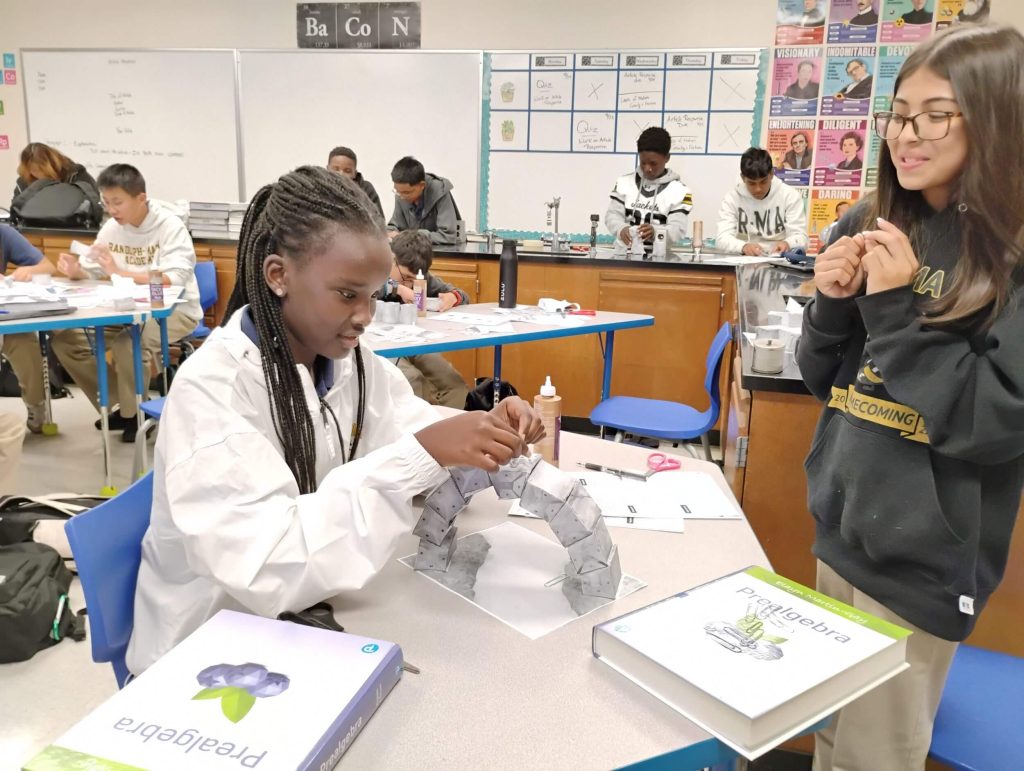
In R-MA’s science courses, cadets explore these skills through hands-on experimentation and inquiry-based learning. Students investigate the principles that govern the physical and living world while building the ability to observe carefully, interpret results, and communicate their findings clearly.
Courses such as biology, chemistry, and physics emphasize critical thinking and scientific reasoning. Laboratory experiences encourage students to test ideas, revise their assumptions, and draw conclusions based on real data.
Through this process, STEM education becomes more than academic preparation. It becomes a framework for disciplined thinking and confident decision-making. How does STEM learning build leadership skills? At R-MA, STEM learning is supported by a curriculum designed to build curiosity, collaboration, and critical thinking. Cadets develop these skills through lab-based science courses, computer science and robotics experiences, and opportunities within the Software and Engineering Pathway.
As they test ideas, solve problems, and refine their work, students build the confidence and discipline that leadership requires.
Innovation Through Robotics and Engineering
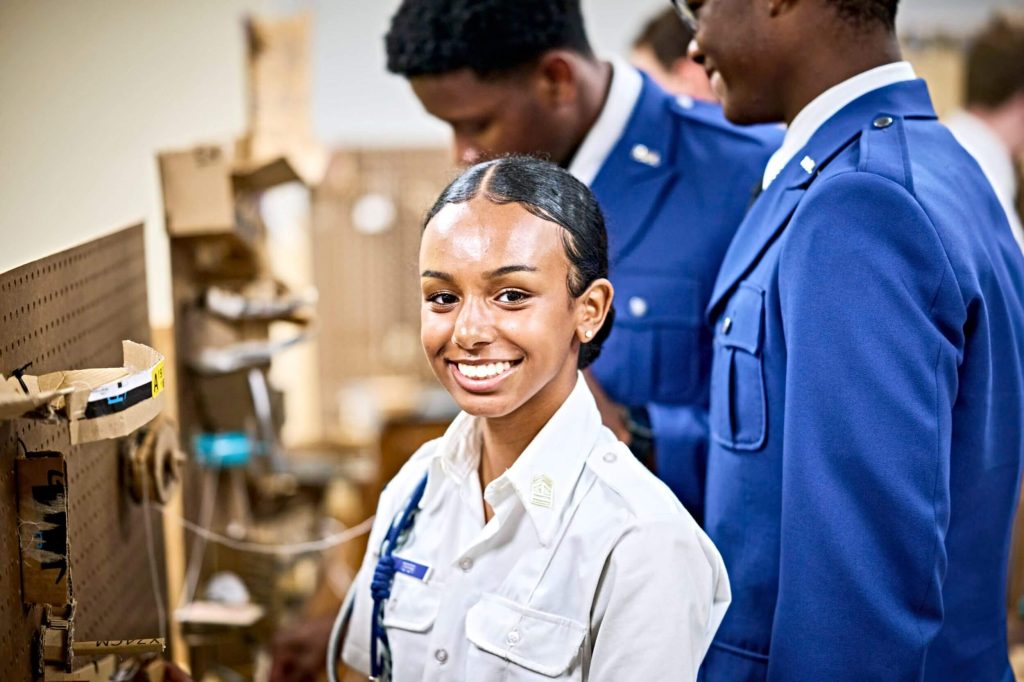
Technology and engineering are central parts of modern STEM programs at R-MA. Cadets interested in computing and engineering explore real-world problem-solving through hands-on projects and programming.
Courses like Introduction to Computer Science with Robotics introduce students to how technology works behind the scenes. Cadets design programs, analyze systems, and experiment with robotics to create solutions to technical challenges.
Through robotics engineering and computer science projects, students learn how innovation happens. They design, test, revise, and improve their work, often multiple times.
These experiences naturally develop STEM leadership. Students learn to organize their ideas, guide group efforts, and persist through setbacks while working toward solutions.
Teamwork and Communication in STEM Projects
Scientific progress rarely happens in isolation. Most technical and personal breakthroughs are the result of teams working together to solve complex problems.
That same principle shapes many STEM education programs at R-MA. Many STEM assignments involve group experiments, engineering challenges, and presentations. Students must coordinate tasks, share ideas, and explain technical concepts clearly while working toward shared goals. Cadets regularly collaborate on laboratory experiments, engineering challenges, and technical presentations.
Working in teams teaches students how to share responsibilities, evaluate different ideas, and communicate complex information clearly. These skills are essential not only for scientific work but also for leadership in any field.By combining collaborative learning with structured mentorship, the Academy helps students strengthen both academic ability and leadership development.
Preparing Students for a STEM-Driven Future
Science and technology continue to reshape the world. Fields such as engineering, cybersecurity, aviation, and medicine all depend on strong foundations in a high-quality STEM education.
At R-MA, cadets explore these opportunities through advanced science and mathematics courses, computer science instruction, and engineering pathways. From studying AP Physics to analyzing data in AP Statistics, students develop the skills needed to pursue challenging academic paths.
These STEM programs for high school students encourage curiosity, persistence, and creativity. They help students understand how scientific knowledge connects to real-world challenges and innovations.
Most importantly, cadets learn that leadership and discovery often grow from the same place: a willingness to ask questions, test ideas, and work together to find better solutions.
At Randolph-Macon Academy, STEM learning is not only about understanding the world. It is also about preparing students to shape it.
Would you like to explore academic opportunities at our preparatory school in Virginia?
Contact R-MA for more information.
Key Takeaways
- STEM learning at R-MA supports both academic growth and leadership development.
- Hands-on experiences in science, robotics, and computer science help cadets apply knowledge in practical ways.
- STEM projects encourage teamwork, communication, and evidence-based decision-making.
- Courses in areas such as biology, chemistry, AP Physics, AP Statistics, computer science, robotics, and cybersecurity help students prepare for future academic and career pathways.
- R-MA’s college-preparatory environment helps students build confidence, discipline, and problem-solving skills through STEM education.
- STEM learning at R-MA is not just about mastering content. It is about learning how to think clearly, work effectively with others, and lead with confidence.
Frequently Asked Questions
What is STEM education?
STEM education focuses on science, technology, engineering, and mathematics. It emphasizes inquiry, experimentation, and real-world problem-solving to help students develop analytical and technical skills.
How does STEM learning build leadership skills?
At R-MA, STEM learning is supported by a curriculum designed to build curiosity, collaboration, and critical thinking. Cadets develop these skills through lab-based science courses, computer science and robotics experiences, and opportunities within the Software and Engineering Pathway.
What STEM programs does R-MA offer?
R-MA offers STEM opportunities through its college-preparatory curriculum, including courses in biology, chemistry, computer science, and advanced mathematics, as well as Advanced Placement options such as AP Biology, AP Chemistry, AP Statistics, and AP Physics. Students can also explore technology-focused learning through robotics, cybersecurity, and the Software and Engineering Pathway, which emphasizes hands-on problem-solving and real-world application.
How do STEM projects teach teamwork and communication?
Many STEM assignments involve group experiments, engineering challenges, and presentations. Students must coordinate tasks, share ideas, and explain technical concepts clearly while working toward shared goals.